Tuesday, 26 March 2013

The Kinesthetic Life


Like many parents I find I have feelings of guilt because of the amount of time my children spend on their Xbox 360, not so much because of the lack of cardio-vascular exercise that this implies but more because of the bad kinesthetics they are picking up from it. And what is kinesthetics? It is the body's sixth sense (forget 'seeing dead people'). Kinesthetics is "the sense of muscular effort that accompanies a voluntary motion of the body" or, as the great intellectual Jacob Bronowski put it in his 1965 essay The Identity of Man, "the kinesthetic sense is an inner signal that runs parallel with our own outward action". Bronowski, for anyone who hasn't seen The Ascent of Man, was intent on unifying both art and science - the world of meaning and the world of mechanics - in the whole man (or woman), and kinesthetics was central to his task.

So kinesthetics is the sense responsible for our desire to play the air guitar or air drums, or to tap our feet or dance on hearing music (or, more specifically, rhythm), or to punch the air or make a clenched fist on experiencing victory. It's what makes us squirm when witnessing someone else struggle through Total Wipeout. It puts us in readiness on the edge of our seats when watching a 'thriller'. And ultimately it's what teaches us the meaning of effort.

My children not only lack cardio-vascular exercise, but the bad kinesthetics they are picking up means they are inevitably learning to associate actions that require physical effort with simpler feelings in the thumbs and index fingers only. Want to sprint across that compound and throw a grenade? That's push left thumb forward and pull right index finger back. Want to skateboard down that near vertical incline in a crouch and hit the horizontal at max speed? That's right thumb and left index finger. Want to go pee? Ah, that's a bit trickier...

In recent years makers of such 'toys' have recognised a problem here and injected some kinesthetic content into the technology. I quite enjoy playing Ten-Pin Bowling on the Wii because in the swing of the arm and the flick of the wrist I get a sensation that almost corresponds with the result. (If only the Wii remote weighed as much as a bowling ball!) The Xbox 360 Kinect has tried to take this a step further with its whole-body motion-sensing, but there still seems a dis-Kinect between the effort required of the body and the effort required on the Xbox. More often than not you'll bash into your living room walls before you bash into an object on screen.

The lack of kinesthetics is a problem in schools as well. I am convinced that children are learning to read slower than they did in the past because they are not learning to write in quite the same way. The letters that children must sound out are not being associated with the kinesthetic sensation of pushing and pulling a pencil along a piece of paper. Each letter written has its own kinesthetic feeling, which is lost when children use keyboards to write, and so children must rely on sight alone to identify the letter before them, making it all the harder. But that's a topic for someone else's blog...

This somewhat chilling article in the Daily Telegraph highlights a more dangerous consequence of the world losing its kinesthetic sense. Controls in some Airbus planes are now so computerised and simplified that pilots can no longer feel the manoeuvres (literally, 'the work of the hand') they are initiating. "Pilots cannot sense the power setting by touching or glancing at the throttle levers. Instead, they have to check their computer screens." In other words, they have to rely on one of the five traditional senses. But in using only these senses we are essentially passive receivers of information. Man and his five senses are made active through the kinesthetic sense.

The crucial element of kinesthetics is the feeling of using our muscles to overcome the resistance offered by the external world. To traverse distance we must move the legs, overcoming friction on the ground, in the air and even in our legs themselves. As the world pushes back against our will we are able to moderate our effort, to increase or decrease it accordingly, so that the resultant net movement is both smooth and controlled. If we did not have the world pushing back at us in this way we would be quite unable to calibrate our own self-consciousness, and we'd be unable to distinguish our waking from our dreaming. Everything would be either impossible or impossibly easy. So the harder the world pushes back, the greater the kinesthetic sense and the greater the sense of being alive to the earthly possibilities that exist.

The next time you run, my advice is this: feel your feet in your shoes, feel your legs, feel the ground, feel the incline, feel the wind, feel your breathing, feel the cold, feel the sweat, feel the beat, feel everything that is working with you and at the same time against you. What you are feeling is yourself in the world but changing the world. That's life; that's kinesthetics.

Sunday, 17 March 2013

Man v. Gravity

Wirksworth Incline
Man is at his noblest when fighting against and overcoming the laws of nature, and there ain't no law tougher or more unforgiving than gravity. Just ask the people at NASA.

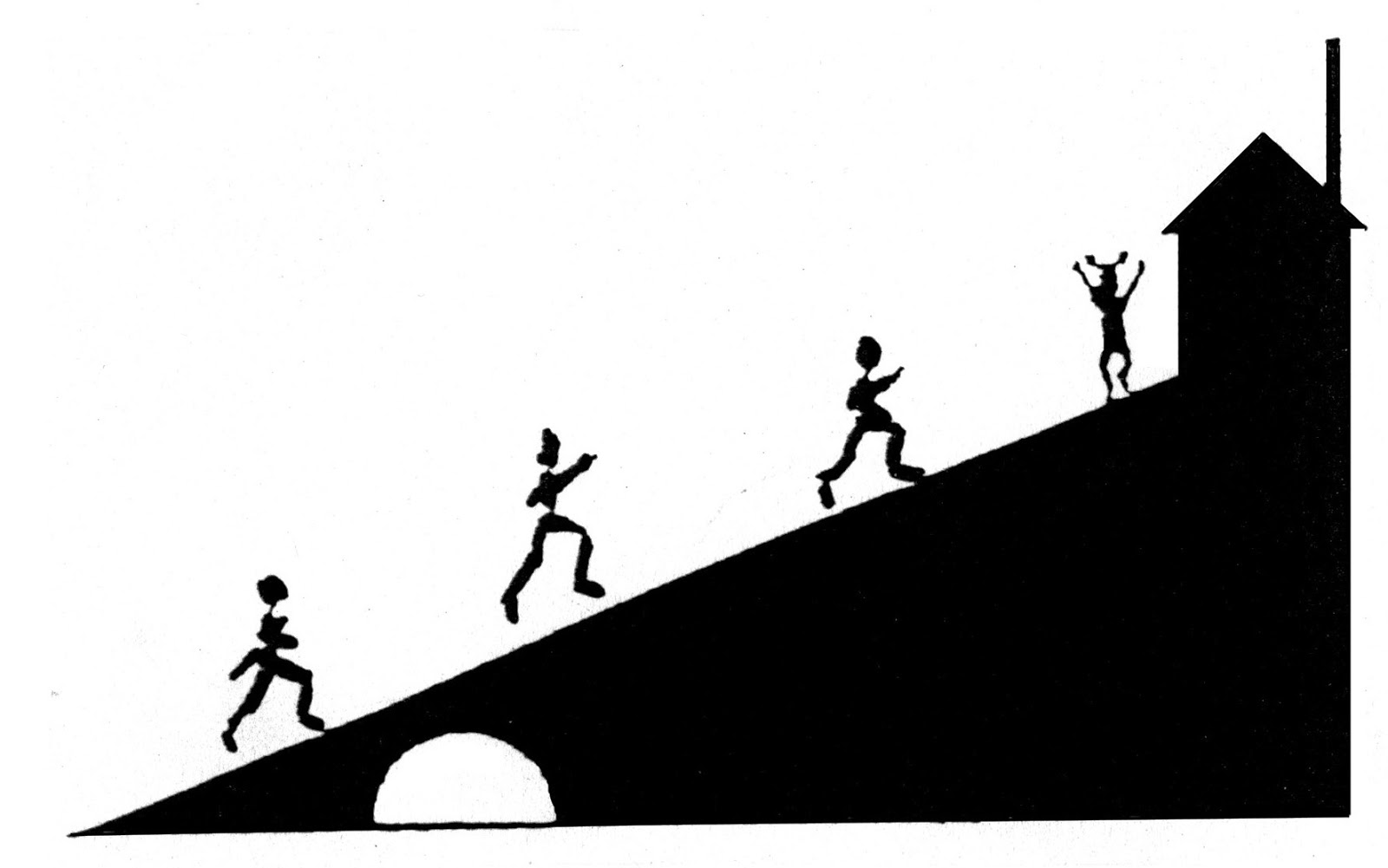
This morning saw me arrive in Wirksworth, Derbyshire, for Wirksworth Running Club's annual 4 mile Incline race - which consists of 2 miles up and 2 miles back down. The total climb is approximately 550 feet, but the most testing part is a half-mile section of the High Peak Trail that has a 1 in 10 gradient.

Most days it's possible when you're running on the level to give yourself the impression that running is a sort of freedom: your workaday cares seem to fade when you bounce along the road; you can calmly take in the views you miss when you're hurrying along in a car; you can almost philosophize. But all it usually takes is a slight incline to bring you back down to earth. And the Wirksworth Incline will certainly knock the philosopher out of you for a good half-hour.

In any case, while philosophy is perhaps not best conducted while ascending a 1 in 10, any philosophy that ignores man's being confined to the low points and dark places by gravity is not going to be able to truly celebrate those times when man (and within this concept I include every woman) has scaled the heights, be they the summit of Everest, the surface of the Moon, or even that pinnacle of intellectual effort the Critique of Pure Reason. You don't necessarily have to be sitting in a leather armchair, surrounded by books, to express an idea. Actions speak as loud as words, and the refusal to be pinned down by gravity, to instead chase down the summit of a hill, to lift in turn each leg while feeding oxygen to the blood like a grimy engineer feeding coal into a boiler, these express an idea of man's nobility and greatness.

Personally I love the climb - that's where I make up a few places by a judicious and well timed swinging of the arms. Coming down is harder. On the decline my legs, which feel like they are running too fast, are never quite running fast enough. If I'm lucky I don't lose as many places I gained on the climb. Today I was lucky. I lost only one place on the downhill, to a heavy breather whom I couldn't shake. But right this minute I can't be sure whether that place was taken from me fair and square or whether I simply gave it away. The 'nobility and greatness' I expressed on the uphill was not easily retained on the down. Never mind. I'll get it and keep it next year.

Wednesday, 6 March 2013

The Fitness Concept

Holly Hayes Wood

"Conceptions without perceptions are empty". That was the nagging idea circulating round my head as I pushed hard during last Sunday’s cross country run (the last of the season) at Holly Hayes Wood near Coalville. It’s funny how the body does that when you run. At your run-all-day pace you can be creative and think up solutions to your problems. But when you’re pushing hard the higher faculties shut down, and your body does the 'thinking', concentrating just on the important stuff like breathing, lifting the knees, and swinging the arms. At this pace you’re mind is left only with the remnants of a thought: a half-remembered phrase that becomes a mental chant to be repeated in time with your stride.

Why that particular phrase at Holly Hayes? Well, Kant says something like it in the Critique of Pure Reason to imply that the rationalist philosophy is unable from its own resources to arrive at knowledge - it needs the content provided by experience to make its concept meaningful. I’m perfectly sure that Kant did not have running in mind when he wrote those words, but for a moment last Sunday I thought they might apply: tackling an incline through the trees whilst listening to the heavy gasps of a fellow runner on my tail I became desperate to inject some perceptions into my conception of fitness.

It seems that we are all increasingly concerned with physical fitness, and the world seems divided sometimes between those who are ‘fit’ and those who are not. But does the concept of fitness neatly divide into an either/or condition like that? Is the concept meaningful at all without a set of circumstances to which it can be applied? In other words, we must ask "Fit for what?" This is where the race comes in. Before Sunday's race I would have replied “Fit enough to run” if asked. But during the race I, like every runner, was given the opportunity to fine tune my pre-race fitness assessment. As I kicked up the incline with the heavy breather ready to take my place at a split second’s notice I knew, at that moment, that I was at least fitter than him, but not quite as fit as the runner just ahead who had already reached the crest.

As my position fluctuated during the remainder of the race so did my assessment. And so did my view of who was doing the assessing (viz. me). I was not simply measuring my fitness, I was playing with the concept. At various points in the race I was deciding that "I don't fit in here, I'd fit better over there, just the other side of the runner in front". And just behind me many others were 'playing with the concept' in the same way (I'm not bloody Superman).

Kant was right: for any concept to apply it needs to be filled with intuitions that we actively provide for ourselves. The race is the perfect place to get them.

Wednesday, 27 February 2013

Meeting Yourself

"I read about the deep mystique of road running, the soul searching and the fact that you meet yourself out on the road - I've never met myself anywhere, let alone on a stretch of road in the middle of Brighton."
(Ovett: An Autobiography, Steve Ovett with John Rodda, Willow Books, 1984, pg 35)
I picked up Steve Ovett's very entertaining autobiography in the Cats Protection charity shop recently. A quid for pure gold. As I remember from his occasional television interviews at the time, he comes across in the book as knowing exactly who he is and exactly what he is capable of. His bloody-minded refusal to 'play the game' that was English Athletics back in the 1970s and '80s made him appear arrogant, but also gave him his victories, his records and his gold medals. Unfortunately, such fierce independence can also blind you to other possibilities, as the quote from Ovett's autobiography shows. It may be that he was so self-sufficient that he needed no one else, not even another version of himself.

I'm no hippy, but I disagree with Steve. It is possible to 'meet yourself' when out for a run, insofar as human beings have always experienced new facets to themselves whenever they have put themselves to the test, and sought out new experiences and explored new regions. The men who walked on the moon came back different people; those who partake of social revolutions also feel transformed. Running can sometimes give you a taste of the same.

I'm not talking about the mere act of putting one foot in front of the other. Nor do I think that running simply 'to get away from it all' necessarily puts you in touch with your inner self. You don't get privileged access to yourself just by trying to escape from the real world. But you can see a new side to yourself when you're wrestling with a new object, never before encountered. In some cases that new object is the moon; in others it might be society itself; in the case of running it is your own body.

Unless we are ill or exercising hard we rarely think of our bodies. To the sedentary, academic intellectual our bodies are simply a precondition for having grand and abstract ideas, which may or may not be true. It's amazing what the mind can think up when not physically tethered. But the mind can be more creative when it is tethered to something real, out there, objective. And when the runner begins to push himself or herself beyond previous limits we have a situation in which a mind is grappling with an object under wholly novel conditions. Under such conditions our inner selves need to be able to 'read' our bodies and interpret their messages; we need to be able to place our bodies in the positions we want them to be in, and try to work out why when this proves not to be possible. When Hamlet coined the phrase 'the undiscovered country' he would have been better applying this to the final furlong of a 5k road race than to the afterlife.

Running round the block without breaking a sweat is not going to do this for you. But enter a race, and I guarantee you'll meet yourself.


Sunday, 24 February 2013

The Runner's Moral Sense


This morning marked the beginning of my 2013 road racing season with the Weston Run. I'd not trained specifically for it, but in recent months I have done a few longer runs in preparation for a half-marathon in May, and I've now got a good few cross-country races in my legs, so I was hopeful of a good time over its 5 mile course.

We all like a good time but runners are quite specific about what they mean by "a good time". As it turned out my good time was 35:14 minutes - about 30 seconds faster than my previous best over this distance. I was very pleased with this. Not because it was a personal best, but because I knew that, given who I was at 11am this morning, I couldn't have run it any faster.

Many a time over the last year since I started running seriously I have crossed the line and felt, once the breathlessness has passed, that I had not given it 100%. This is a judgement you pass on yourself, and is not based on your time; it is based on your moral sense. Somehow you know that, though you achieved a PB, you could have gone faster. Or, though you didn't achieve a PB, you gave the race everything. I think it debatable which one of these options is the better. But today I was lucky: I gave it my all and got the PB.

And what is your all? It's easy enough to declare, before the race starts, that this is what you will give it. But what does it mean after you start? I don't think it means sprinting off in front of the leading pack (for some it does, but not - perhaps never - for me). Neither is it something you can measure physiologically: your 'all' is not easily expressed in terms of minutes per mile or maximum heart rate.

Rather, your 'all' is what you give when your moral sense is delicately poised between pushing too hard and cruising along. I don't know about you but my body has a natural tendency to cruise, perhaps in someone's slipstream, perhaps at a 'reasonable' pace determined by stopwatch and mile-markers (I don't own a Garmin), or perhaps a polite distance behind a fellow club-runner whom you 'know' is faster than you. Cruising isn't easy. It certainly isn't conversational. So pushing harder than this requires a moral decision to make yourself slightly less comfortable ('comfort' being a relative concept in racing), to be slightly dissatisfied with who you currently are, to commit to gaining on the person in front. And how many times need you make this decision? I would say in a 35 minute race about 1,050 times. About every 2 seconds.

Pushing hard is mentally as well as physically exhausting. The runner's moral sense can oscillate between body and soul like an up-tempo metronome from the moment the gun goes off to the moment the finish funnel is entered. But unlike your body, your soul is ready to go out again almost immediately, in the knowledge that you're a slightly bigger person than you thought you were.

Saturday, 23 February 2013

Kant's Weekly Mileage


Kant was the type of runner known as a walker. I read on this website that every day at 3.30pm he would emerge from his lodging, wearing his cocked hat and a long-coat and carrying a rattan cane and would walk up and down his street exactly 8 times, covering a distance of 4 miles. That makes 28 miles per week, further - I would hazard - than many present-day runners.

Let's not discuss Kant's heart rate while he racked up the miles. For the sake of argument let's assume that he wasn't going at 90% MHR, but that it was raised by his exertions. He might well have chosen to cover 4 miles because it took him around an hour, which would make him a 15 minute miler. Respectable for a 5 footer with a bad back and a non-wicking long-coat.

Read any biography of Kant and it will mention his walking as a quirk, a remarkable feature in an otherwise unremarkable life, by which the citizens of Königsberg could set their clocks. With few exceptions, Kant's biographers have never been able to reconcile his sheltered existence with his revolutionary philosophical works. It is interesting, they say, that the life of the philosopher who effected a 'Copernican Revolution' and totally reshaped modern thought should be so dull in comparison.

But is Kant's commitment to 28 mpw merely a comparative dullness? Is his mileage not, rather, the key to his entire transcendental philosophy? What else could have constantly reminded him, as he broke into a sweat and increased his breathing rate, that there was more to being than abstract thinking, and more to philosophy than Wolffian rationalism. David Hume may have awoken Kant from his dogmatic slumbers, but I'll wager it was his daily exertion that kept Kant alive to the possibility of human thought transcending itself and grasping the empirical world.

Of course, as runners we know that thinking is bound to the respiration process, and that the noblest of theoretical enterprises is tied - somehow - to the acts of moving and breathing. As runners we are philosophers. Each time we lace up we take the first few steps along the Kantian road.

Tuesday, 19 February 2013

Making your Move


Earlier this month I ran in the Derby Runner League's two lap, 5 mile cross-country race at Foremark Reservoir. The thing about a two lap race is that you know exactly where to make your move. The first lap should have revealed as much of the course as you need to know: the turns, the chicanes, the hills, the mud baths and the finish funnel. So on the second lap you've no excuses. You cannot blame the finish for coming too quick, before you had a chance to kick for home. Nor can you accuse it of coming too late, after all your energy is spent.

On a two lap cross country race you know exactly who your opponent is. I'm not talking about the race favourite - not all of us can consider ourselves potential race winners; nor am I talking about your friendly club rival - all that goes out the window after the starter pistol goes off. Your true opponent is the runner in front when it comes to make your move. Or the runner who is breathing down your ear at that same moment.

This is a runner whom you have probably never met before, and to whom you will probably never introduce yourself. You might never see their face. But you'll recognise their breathing and their gait, and you'll know that, with only so many seconds before the finish funnel swallows you both, it's either them or you.

But wait just a minute. This is what you know. But what do you actually want? The rational mind - either before or after the race - knows that victory is preferable to defeat. But in the race itself, at the very moment when you must make your move, what is your heart's desire? Is it to win?

Perhaps if I asked what is your heart and lungs' desire, the question would not be so straightforward. At that particular point in the race they have their own agenda, and can be quite eloquent about it too. Sure, they can scream in pain, but they can also express complex ideas. Like little devils on your shoulder they can say "You've done enough today. Your final position doesn't matter as much as an even pace all round. Save yourself for the next race. Let the other guy kill himself if he wants. Don't give him the satisfaction of a sprint finish". Believe me, I have heard these voices. They are reason's last gasp.

When it comes to the moment of truth, your heart's desire can become a matter of sheer indifference. When it lies within reach, as a result of your own superhuman effort, the simple matter of plucking it seems the last thing you want to do. But 'twas ever thus. If it became easier to fulfill your desires the nearer to them you got, then mankind would have  succumbed to and died of sloth several thousand years ago. The truth is, the nearer we get to them the harder they are to reach. But the final challenge is no mere exercise in problem-solving - it is a moral test of human will. In the final few seconds of a race, if you are to go up against your opponent, your will must go up against your reason's siren-like ability to bring it down. When the funnel is in sight, my advice is to stop up your ears with beeswax and kick harder.